
Salt Lake County Directory Collections
The strongest local route is the Utah Historical Society digital collection and the University of Utah Marriott Library catalog. The society describes directories as lists of residents, streets, businesses, organizations, and institutions arranged by name, geography, or publisher. A directory may also contain ads that reveal a business name or neighborhood setting. Catalog evidence confirms individual volumes and year examples, not a complete uninterrupted run.
| Collection | Years or coverage | Where held | Access |
|---|---|---|---|
| Salt Lake City Suburban Directory, R.L. Polk | Verified 1975 item; county communities named in metadata | Marriott Library digital item | Digitized catalog record |
| Utah Historical Society directories | Visible catalog examples from 1884 through 1989-90, with gaps | Utah Historical Society and University of Utah collections | Browse and collection-specific access |
| Polk address pages | After 1924 guidance, where a volume includes the section | Historical Society research center | Name and address research |
| Local newspapers and clippings | Deseret News 1867-Jan. 2015; Salt Lake Tribune 1959-Jan. 2015 | Salt Lake City Public Library Archives | Mostly in-library microfilm and files |
| State Archives and FamilySearch | Utah records 1848-2001 in the digitized collection | Utah State Archives and FamilySearch | Search, image, or collection rules apply |
The verified 1975 suburban item names Draper, Granger, Holladay, Hunter, Kearns, Magna, Midvale, Murray, Riverton, Sandy, South Jordan, Taylorsville, Union, West Jordan, and White City. That list makes the volume a county-scale source rather than a narrow downtown directory. It should still be cited as one year and one title.
Salt Lake County Directory Reading Notes
Record the title exactly as cataloged, including publisher and edition year. Then save the collection URL, volume or reel identifier, page number, section heading, and any abbreviation key. A scan can be searchable while still omitting a page, image, or reverse section from the public view. If a surname appears in one year and disappears in the next, treat that as an observation to investigate, not proof of a move. Compare the address page, name page, newspapers, and property sources before drawing a historical conclusion.
Years, Gaps, and Catalog Proof
The University of Utah browse examples include 1953, 1955 through 1959 suburban volumes, 1962 through 1968, 1970 through 1975, 1970-71, 1971 suburban, 1972 through 1975, 1980 suburban, 1981 through 1983, 1985, and 1987 or 1989-90. Other catalog entries identify 1884, 1890, 1892-93, 1917, 1934, 1970, 1972, 1975-76, 1977, and 1978-79. These are verified examples visible in the browse and catalog, not a claim that every intervening year exists.
Use a gap as a research fact. A missed year may reflect publication practice, cataloging, digitization, or a volume held elsewhere. The catalog browse route can show what is discoverable at the time of search. Save the title, publisher, year, volume, page, and collection identifier before moving to the next source.
Historical snapshot. A city directory entry can be useful for a past address or family trail, yet irregular publication and survey methods make it unsuitable as current residence proof.
Reading a Salt Lake County Entry
Begin with the page’s own heading and arrangement. A name section may place surnames in alphabetical order. A geographic section may group streets, blocks, or address ranges. A business section may sort by trade or organization. The Library of Congress guide notes that city-directory entries can include personal, professional, civic, spouse, and occupation information, while the Historical Society guide points to both name and address use. Do not assume that every volume uses the same fields.
- Record the person or household name exactly as printed.
- Capture the address, street direction, and unit or number when visible.
- Note an occupation, spouse, business, or civic detail only if the page shows it.
- Copy the publisher, volume year, page, section, and any abbreviation key.
- Mark whether the entry is a name page, street page, business page, or advertisement.
The research file does not contain a page-level sample entry or abbreviation key from the 1975 scan. That gap matters. A finished citation should not invent owner or renter marks, initials, or shorthand. Inspect the actual page image or PDF before describing a symbol, and use a short source note instead of copying a full personal entry.
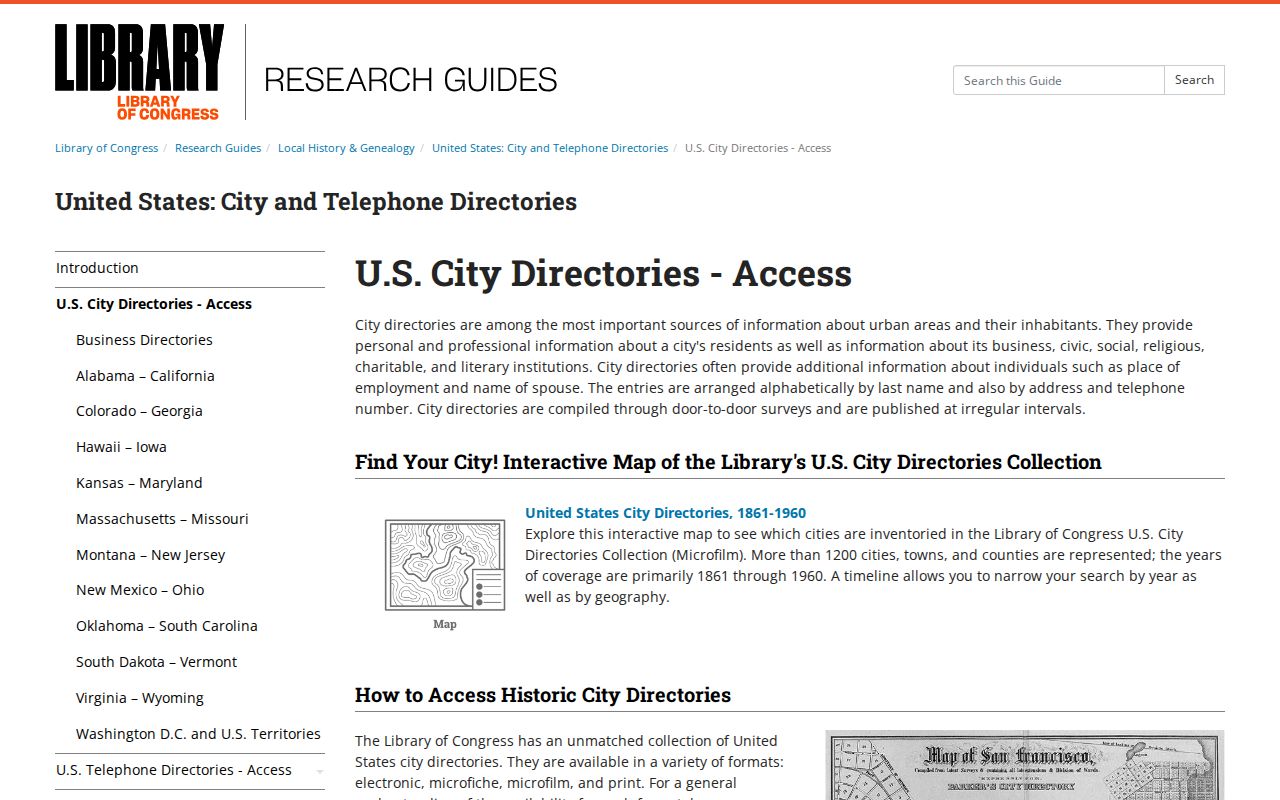
The Library of Congress city-directory guide gives broader context for how directory pages can be arranged and read.
Polk Pink Pages for House History
The Utah Historical Society’s house-history guide says Polk directories make it possible to find who lived in a Salt Lake, Ogden, or Provo house after 1924. The reverse or address pages are historically called the “pink pages.” They are the key tool when a parcel or street is known but the past name is not. Search the address section, write down the page, then repeat the search in nearby years rather than treating one listing as a continuous household.
For a current address trail, the address-focused Salt Lake County street directory page owns the Assessor, GIS, deed, and permit chain. The city directory route stays with the historical collection, citation, and interpretation work. A directory name can be a former occupant, a head of household, or a business listing, depending on the volume.
The Utah Historical Society house-history guide explains the post-1924 address-page route.
Tracing a Household Across Years
Choose one address and one known anchor, such as a surname, spouse, business, or nearby street. Then walk through the records in order. Census years can supply a broad household check, while directories fill some of the years between census snapshots. A deed or tax card can confirm that the property existed and identify an owner, but it does not by itself identify every person in the home.
- Write the modern address and all known historic spellings or street directions.
- Find the earliest confirmed directory volume, recording title, year, page, section, and publisher.
- Check the address or name section in the next available volume and mark each change.
- Pair the directory years with a census, deed, tax card, newspaper, cemetery, or permitted vital index.
- Explain gaps plainly, distinguishing a missing volume from a missing household entry.
FamilySearch’s Utah State Archives collection can add digitized civil, criminal, divorce, probate, and naturalization records from 1848 through 2001. State Archives supports name or keyword and date searching, with Salt Lake County birth-register material from 1898 to 1905 and probate civil or criminal records from 1852 to 1887. Those records can help verify a relationship or event, but they are not substitutes for the directory page.
Library Shelves and Local News
Salt Lake City Public Library Archives is at 210 E 400 S, Salt Lake City. The Main Library lists hours Monday through Thursday 10 to 8, Friday and Saturday 10 to 6, and Sunday 11 to 5. Archives and Special Collections hold newspapers on microfilm, local clippings, photographs, maps, ephemera, scrapbooks, and local-history books. Scanners and microfilm readers are available, and archives@slcpl.org is the contact route. Many materials are in-library only.
Newspapers often explain an address change that a directory only hints at. The County Archives FAQ lists Deseret News, Salt Lake Tribune, New York Times, and Wall Street Journal runs, with only the New York Times indexed in the listed volumes. Chronicling America lists Salt Lake Telegram holdings from 1915 to 1952. Search by surname, street variant, neighborhood, funeral home, or approximate date, then cite the newspaper title and page rather than copying a full notice.
Utah Archives for Older Trails
The Utah State Archives research route offers name and keyword searching, date filters, series information, digital archives, and records from Utah government history. The FamilySearch collection extends from 1848 to 2001 and includes Salt Lake County civil and criminal, divorce, probate, and naturalization records. County Archives separately lists births from 1890 to 1911, deaths from 1847 to 1949, marriage licenses from 1887 to 1904, and land certificates from 1851 to 1895 in its online material.
Use these collections to test a directory clue. A death index, marriage license, probate entry, or newspaper notice may confirm that a person belongs to a time and place. Access rules remain tied to the custodian. A directory entry should be labeled as a directory entry, not promoted to an official vital record.
The Utah State Archives research page is the source for older state-custody searches and series context.
Citing a Directory Carefully
A useful citation lets another researcher return to the same page. Keep the title, publisher, year, volume, page, section, collection, and URL when one is available. For a scanned item, preserve the catalog identifier and the date accessed. If a reverse page is absent or not inspected, say so. The research record’s page-level sample gap should remain visible until a lawful page image has been reviewed.
- Householder index
- A name or household listing arranged to help find a person, often separate from an address section.
- Criss-cross directory
- A directory that links names and addresses, often through a reverse or street arrangement.
- Abbreviation key
- The volume’s explanation of shortened words or symbols. Use the key from that volume, not a guess from another year.
- Snapshot
- A dated record of what a publication listed. It does not establish a present address.
When a historical find needs a modern check, use the custodian that owns the current record. The directory itself remains the historical source, while a parcel, voter, court, or vital record carries its own access and privacy rules.